
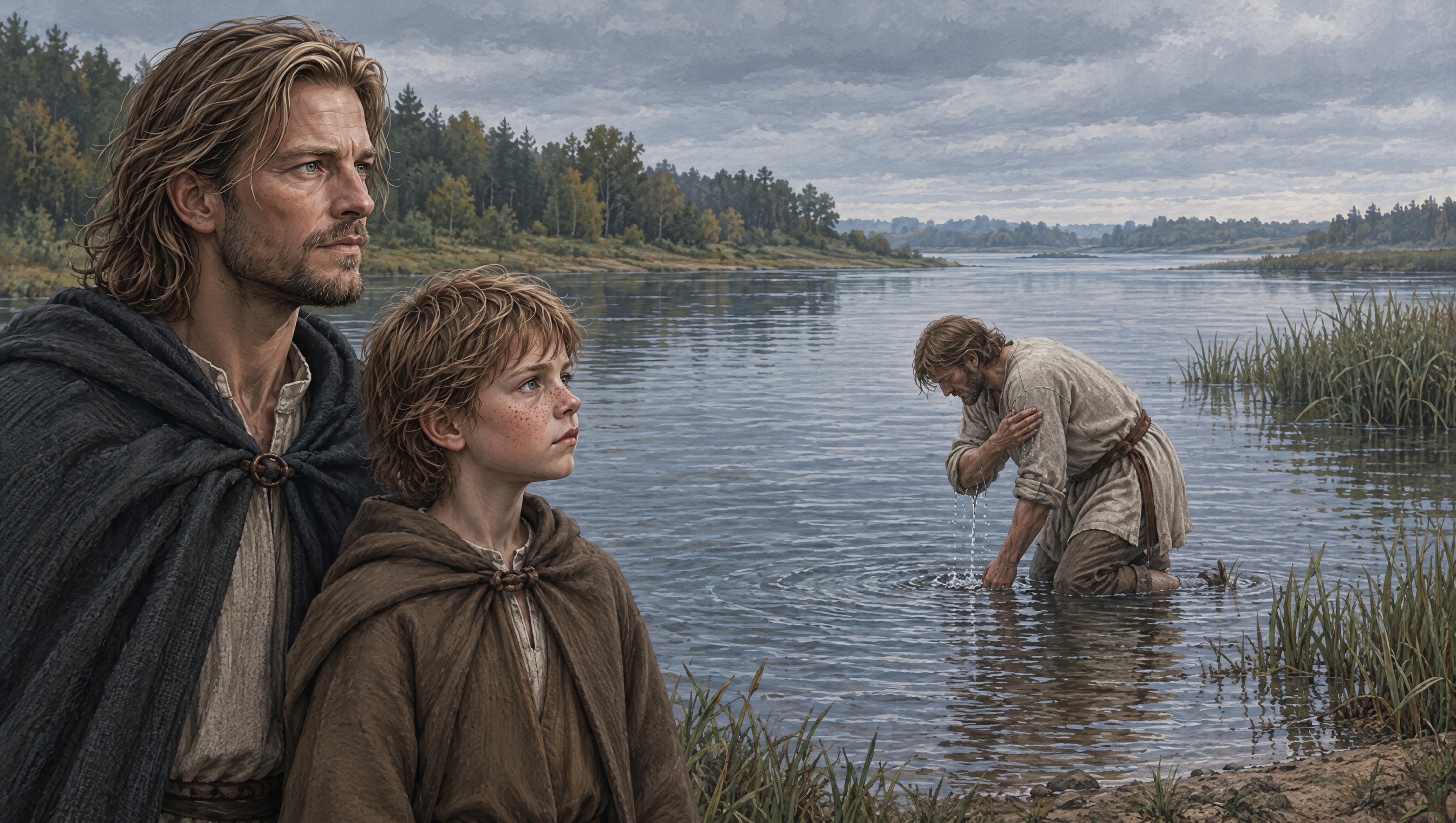
The soldiers were sailing away when, in Henry of Livonia’s account, newly baptised Livonians returned to the water. Emerging from their customary baths, they poured water from the Daugava over themselves. Henry gives them a declaration: they were removing baptism and Christianity with river water, and sending the faith after the departing Saxons. [1]
The gesture brings a larger question into view. A baptism could take place in front of an army. What it meant to the person receiving it was harder to establish.
After the soldiers left
Henry places the scene after the campaign associated with Bishop Bertold in 1198. He describes military violence followed by baptisms and arrangements to support priests. As the soldiers prepared to leave, clergy and a merchant ship remained. The mission would continue in a landscape where acceptance of its ceremonies could still be contested. [1]
At the river, Henry turns that tension into an action. Water had marked the Livonians’ entry into Christianity; now they used water to express rejection. In the words he attributes to them, they were sending the received faith after the Saxons. The scene presents conversion as something the people undergoing it could dispute, even after the ceremony was over. [1]
That does not tell us exactly what each participant believed. It does show how a Christian chronicler chose to describe resistance to the mission: through people taking a familiar substance and giving it a meaning the missionaries would not accept.
The voice that preserved the refusal
We hear this story through Henry, a Christian priest. There is no matching Livonian account here to set beside his description. His choice of scene and the speech he gives its participants shape what reaches us. Research on direct speech in the chronicle treats these voices as part of Henry’s storytelling, rather than as surviving transcripts of conversations. [2]
That distinction matters because the scene is so vivid. We can follow the action he describes without assuming that we possess the participants’ exact words or private thoughts. Nor should one episode stand for every Livonian response to Christianity, or suggest that the longer process of conversion ended at the river.
What remains striking is that Henry preserves the refusal at all. His account records the baptisms, then carries us beyond them, to people contesting what had been done. The soldiers could leave after the ceremony. The meaning of conversion remained unsettled.
THE STORY IN MOTION
Watch the story
See the scene brought to life in The Baltic Code’s short film.
Press play to load the YouTube player. Watch on YouTube ↗
Sources & historical notes 2 references
- Henry of Livonia, Chronicle, Book II, sections 7–8. Latin text with Estonian translation by Richard Kleis, Henriku Liivimaa kroonika. ↗
Primary narrative for the baptisms, the soldiers’ departure and the washing episode. Written from the Christian missionary perspective; reported speech is not a verbatim transcript.
Back to the story ↑ - Ramunė Markevičiūtė. Barbarians Speaking — The Historiographical Theater and Its Effect in Henry of Latvia’s Chronicon Livoniae. Literatūra 58(3), 2016, pp. 43–56, especially p. 53. ↗
Especially printed page 53. Examines how Henry constructs direct speech and portrays the people in his chronicle. This is scholarly interpretation, not an independent eyewitness account of the washing.
Back to the story ↑
About the reconstruction
Witness and Young One are fictional guides. Their dialogue and the visual staging are dramatized; the river episode follows the chronicler’s account.