
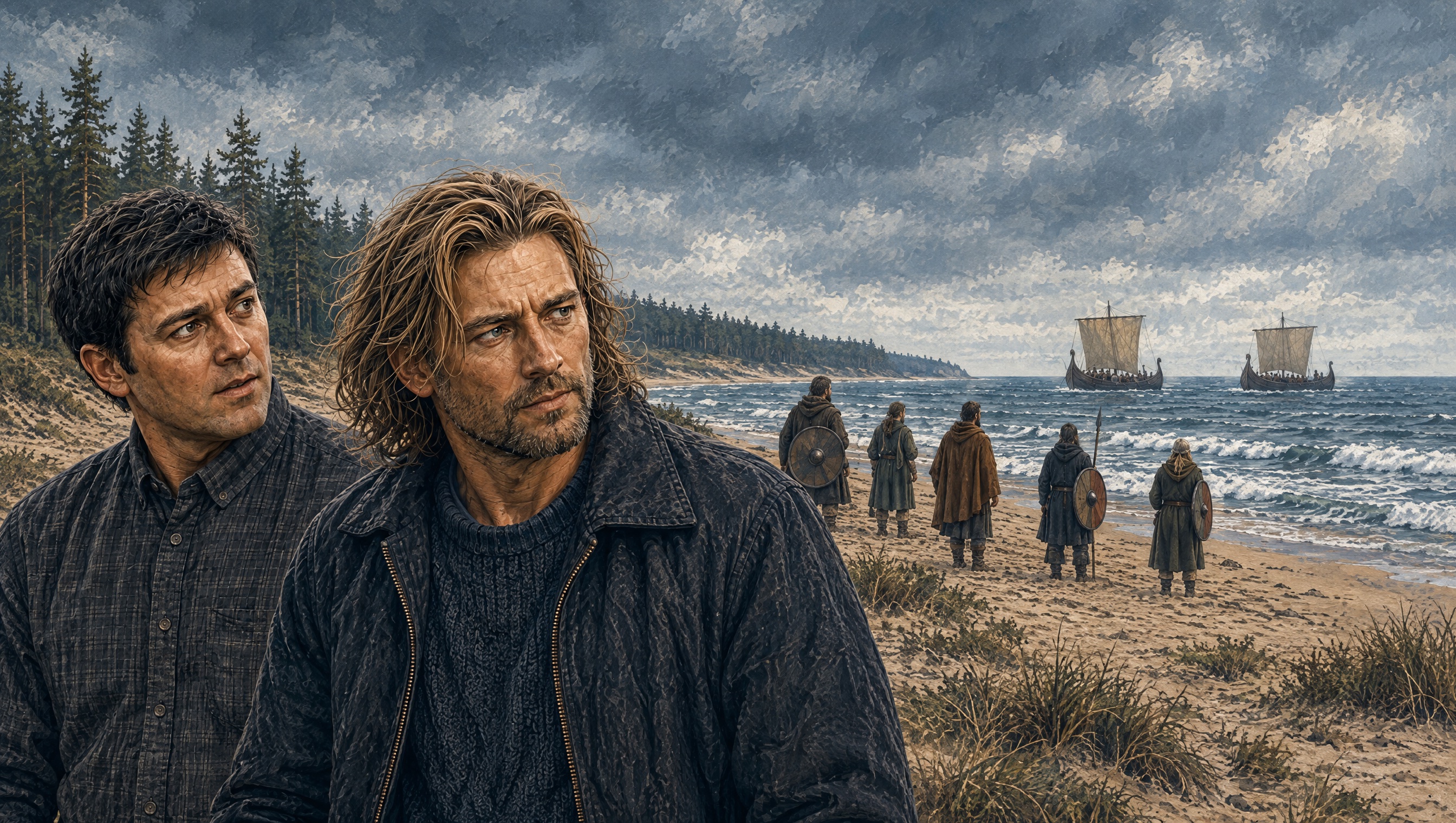
A ship approaches a coast. The familiar story follows the people aboard: their sail, their weapons, the place they hope to reach. Move the viewpoint onto the beach and another story begins. The people watching that ship have homes, possessions and choices of their own.
The eastern Baltic gives us several ways to make that shift. They do not all offer the same kind of evidence. Two buried ships, a Christian writer’s account and a later saga each reveal something different about encounters across the sea.
Ships that became graves
At Salme on Saaremaa, two ships became the burial places of at least forty-one Scandinavian warriors around AD 750. Seven lay in one vessel and thirty-four in the other. Weapons and gaming pieces accompanied them, and the burial practices and objects point towards Scandinavia, probably central Sweden. [1] [2]
It is a powerful ending to a journey, but it leaves much of the encounter unanswered. The graves cannot name the people who opposed these men or reconstruct the whole sequence of their deaths. Calling Salme a proven victory by a named local force would turn that gap into an invented certainty.
What the discovery does establish is a Scandinavian presence on another shore, preserved through the people who never returned. It asks us to look beyond the departure of the ships and consider what happened when they arrived.
When the shore fought back
Rimbert’s ninth-century Life of Anskar offers a more explicit reversal. In chapter 30, Danish ships come to the people he calls the Cori, generally identified as the Curonians, seeking their wealth and submission. The inhabitants gather to resist. In his telling, they win and take gold, silver and other spoil from the Danish ships. [3]
The would-be plunderers lose their own treasure. Yet the chapter continues: a Swedish expedition follows, and the account eventually reaches an agreement involving tribute and hostages. Selecting the Danish defeat alone would make a complicated relationship look like an unbroken record of local victories. Rimbert is writing a saint’s life, with a Christian purpose shaping his narrative. [3]
A hero behind a locked door
Egil’s saga gives the famous visitor a different difficulty. Its Courland episode begins with trading under a temporary peace. Raiding follows, and local people capture Egil’s group, bind them and confine them in a farmhouse. Egil escapes, frees his companions and other captives, and later returns in violent retaliation. His capture is a reversal within a longer adventure, not its final outcome. [4]
The distinction between this story and Salme matters. The Icelandic family sagas were written centuries after the events they describe; this is literary testimony, not a contemporary report of every action. Even so, its coastal inhabitants have initiative and resources. For part of the narrative, the celebrated traveller depends on finding a way out of their custody. [4] [5]
These episodes do not reveal a single Baltic nation facing a single Viking nation. The Swedish History Museum describes a world of smaller communities and shifting political groupings. Here, Baltic names a region around a sea; it does not make Curonians and the inhabitants of Saaremaa one ethnic or linguistic people. [6]
The point is not to replace one invincible warrior with another. It is to notice whose decisions a familiar story leaves outside the frame. Trade, resistance and capture all become easier to see when we stand on the coast and watch the ship arrive.
THE STORY IN MOTION
Watch the story
See the scene brought to life in The Baltic Code’s short film.
Press play to load the YouTube player. Watch on YouTube ↗
Sources & historical notes 6 references
- Saaremaa Museum, Archaeological collection, Salme ship-burial section. ↗
Institutional summary dating the two burials to around AD 750 and identifying at least 41 warriors of Scandinavian origin. The remains do not identify their opponents.
Back to the story ↑ - The Salme Ship Burials: Two Eighth-Century Mass Graves on Saaremaa Island, Estonia. Fieldwork and Catalogue. Tallinn University, 2023, publisher’s introduction. ↗
The linked introduction records seven warriors in Salme I and 34 in Salme II, grave goods and a probable central Swedish origin. We do not claim to have examined the full catalogue here.
Back to the story ↑ - Rimbert, Life of Anskar, chapter 30. Charles H. Robinson translation, 1921. Fordham Internet History Sourcebooks. ↗
A ninth-century saint’s life describing the Danish defeat and a subsequent Swedish campaign. This is an attributed narrative, not a neutral campaign log. Its figures are not treated as precise modern statistics.
Back to the story ↑ - Egil’s Saga, chapter 46. W. C. Green translation, 1893. Icelandic Saga Database. ↗
Read the full Courland episode: trading, raiding, capture, escape and violent retaliation. The capture is not the episode’s ending, and the saga is not a contemporary battle report.
Back to the story ↑ - Icelandic Saga Database, introduction to the Sagas of the Icelanders. ↗
Background on the sagas’ later medieval composition and uncertain facticity. A narrative’s vivid detail does not independently verify each event.
Back to the story ↑ - Swedish History Museum, Who were the Vikings? ↗
Context on local communities, changing political groupings and why Vikings should not be treated as one distinct ethnic group or modern nation.
Back to the story ↑
About the reconstruction
Witness and Skeptic are fictional guides. The cover and video use illustrative historical reconstructions. The Salme sequence does not reconstruct an identified battle or establish its victors; the Courland capture is explicitly a saga episode.